
Their Best Christmas
This was so Unexpected


This article was written by Hartley F Dailey and appeared in Christmas In My Heart 6 (Edited by Joe Wheeler). I placed it in our South African Signs of the Times, November/December 2009. Used with permission.
I thought I would like to feature the Christmas theme in my two next posts. The second one will be sent out on Christmas eve.
John and Mary Channing looked out at the falling snow with understandable bitterness. It was Christmas - and none of their children were coming home, not even those who lived only minutes away.
Suddenly there was a knock on the door. Who could that be? They had seen no car come up the drive.
John Channing looked out the dining room window to where the snow drifted deeper and deeper across his front yard. It was snowing so hard now that the woodlot only 50 metres away, was only a gray blur. A big rift ran from the corner of the house, diagonally across the drive, to join the one that reached out from the grape arbour.
“Christmas!” said John. He almost spat the word. Mary, his wife, looked up from where she was setting the table, startled and a little concerned at the bitterness in his voice. “Don’t take it so hard, John,” she admonished him gently.
He turned from the window to face her, “But Mother, what kind of Christmas is it, all by ourselves? Four kids and a flock of grandchildren, and we have to eat Christmas dinner all alone!”
“Now, Dad,” her voice was even more gentle. “You know Molly couldn’t leave her job in the store during Christmas. If she did there’d be no job, and then how could she finish college?”
“I know that.” He came over and put his arm around her “I know that Leah can’t get home, either, what with living 80 km away, and her children in school, and Tom’s job to think of. But the other two, I find it hard to understand. Debbie’s just eight kilometres away, and Bill only ten. So busy with their own affairs they can’t even spend a couple of hours with us on Christmas.”
“But John, the weather…”
“Bother the weather!” He was angry again. “You know very well they told us they wouldn’t be here, even before this blizzard blew up.”
“Yes, I know.” Her voice was sad, and somehow tired. “But maybe they’ll understand some day. No use fretting I guess. Come, help me carry in the food, then we’ll sit down and eat. At least,” she addd, “they sent presents.”
“Presents.” He looked toward the foot of the tree where the gifts were laid out on the floor, things that he had desired and would later cherish. But just now they might as well be heaps of ashes.
He helped her carry in the food - a very small chicken, a single pumpkin pie, minimal servings of other dishes. And he knew that even these would not all be eaten. Then just as they were sitting down, there was a knock at the kitchen door. He opened the door to find a man standing there - a man who was small, young, and timid, and very obviously not dressed for such weather. He was covered from head to foot with crusted snow and breathing so hard he had to make several attempts before he could utter a sound.
“Please, mister,” he managed at last, “could you help me? It’s my car. It went off the road, must be a kilometre and a half back.”
“Come in, sir!” John opened the door wide. “Now, catch your breath and tell me all about it. Where did it happen?”
“Back that way,” the man gestured vaguely. “There’s a funny bend in the road. I-I couldn’t see where I was going, the snow was so bad. Then all at once it was too late.”
“Devil’s Neck,” John growled. “Happens all the time. Anyone else in the car?”
“My wife and children,” the stranger told him. “I had to leave them there. They couldn’t have made it in the snow. I walked and walked, looking for a house. Doesn’t anybody live along here?”
“For land’s sake, come in, friend,” John was already putting on his boots. “We’ll have to get them out of there. They’ll freeze!” Then in a more gentle tone, he added, “There’s two other houses, but they’re set way back. You couldn’t have seen them for the snow.”
“Mother,” he called, as he put on his coat, “fix up some more food, a lot of it. We’re having guests to dinner. Hungry ones. There won’t be time to cook more chicken or turkey, but you can fry up a bunch of burgers, and put some of your frozen pies in the oven. Oh, what in the world am I telling you for? You know better what to do than I do!” His voice sounded years younger than it had 20 minutes earlier.
As they backed out of the garage, the young man asked, “Aren’t you afraid you’ll hang up in the snow, too?”
“Not a bit,” John chuckled. “I’m prepared. Chains.”
The stranger’s family, besides his wife, consisted of four children, the oldest about 9, the youngest about 16 months. They bundled them quickly into John’s car, but John shook his head sadly over the condition of the other vehicle. It was deep in the ditch, far off the road, and the drift was rapidly building up around it.
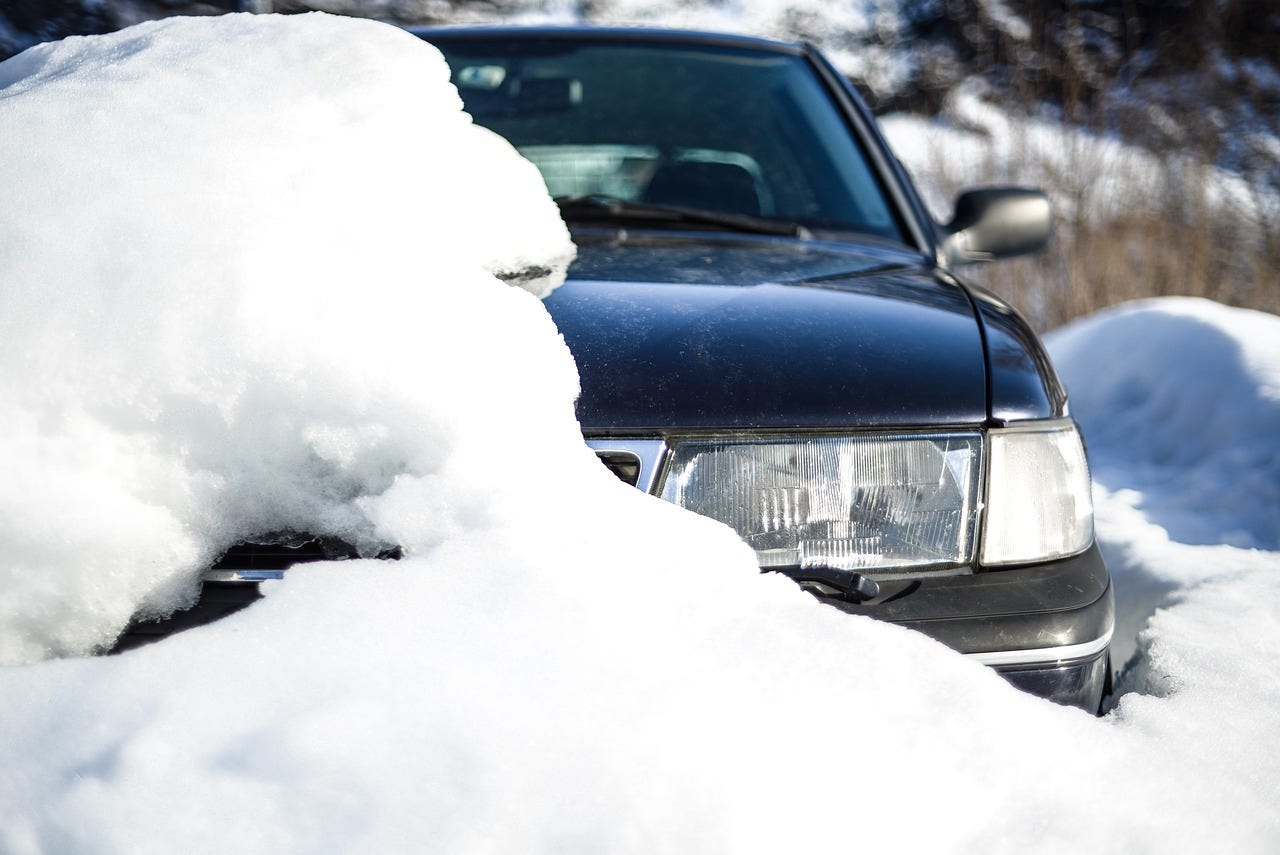
The car caught in the snow drift could have looked something like this. Image by Monika from Pixabay.
“Take a tractor and some shovels to get that out,” he said. “Best thing to do now is to get these youngsters home. Nobody’s going to bother the car here. We’ll come back for it after we eat.”
The big farm kitchen was fragrant with the smell of cooking meat, together with the spicy odour of mince and pumpkin pies. Mary met them at the door, helping the children out of their too thin wraps, showing each one where to stand to get maximum heat from the furnace, taking the smallest one up in her arms, exclaiming over her silky brown hair.
“Just like Molly’s used to be.”
“I think we’d better introduce ourselves,” the young man shyly broke in. “I’m George Lewis. We’ve been living in Chicago, but I lost my job, and we’re going to a job I have been promised down in Tennessee. My wife is Vera. This” - indicating the eldest girl - is Sally.”
“The middle one is Marty, and the baby is Lora. This big fellow is my son, Bob.”
John Channing reaching gravely to shake hands with the 6-year-old, found himself looking into a pair of serious grey eyes that might have belonged to his own son, 18 years before.
“Dinner’s ready, John,” Mary announced. “Don’t let us stand around chatting. These children must be hungry!”
The big dining table was loaded to capacity. John had never ceased to marvel at his wife’s ability to prepare a good meal in a hurry. There was a huge platter of burgers, of course, and, amazingly, a great bowl of mashed potatoes. How had she managed those in such a short time?
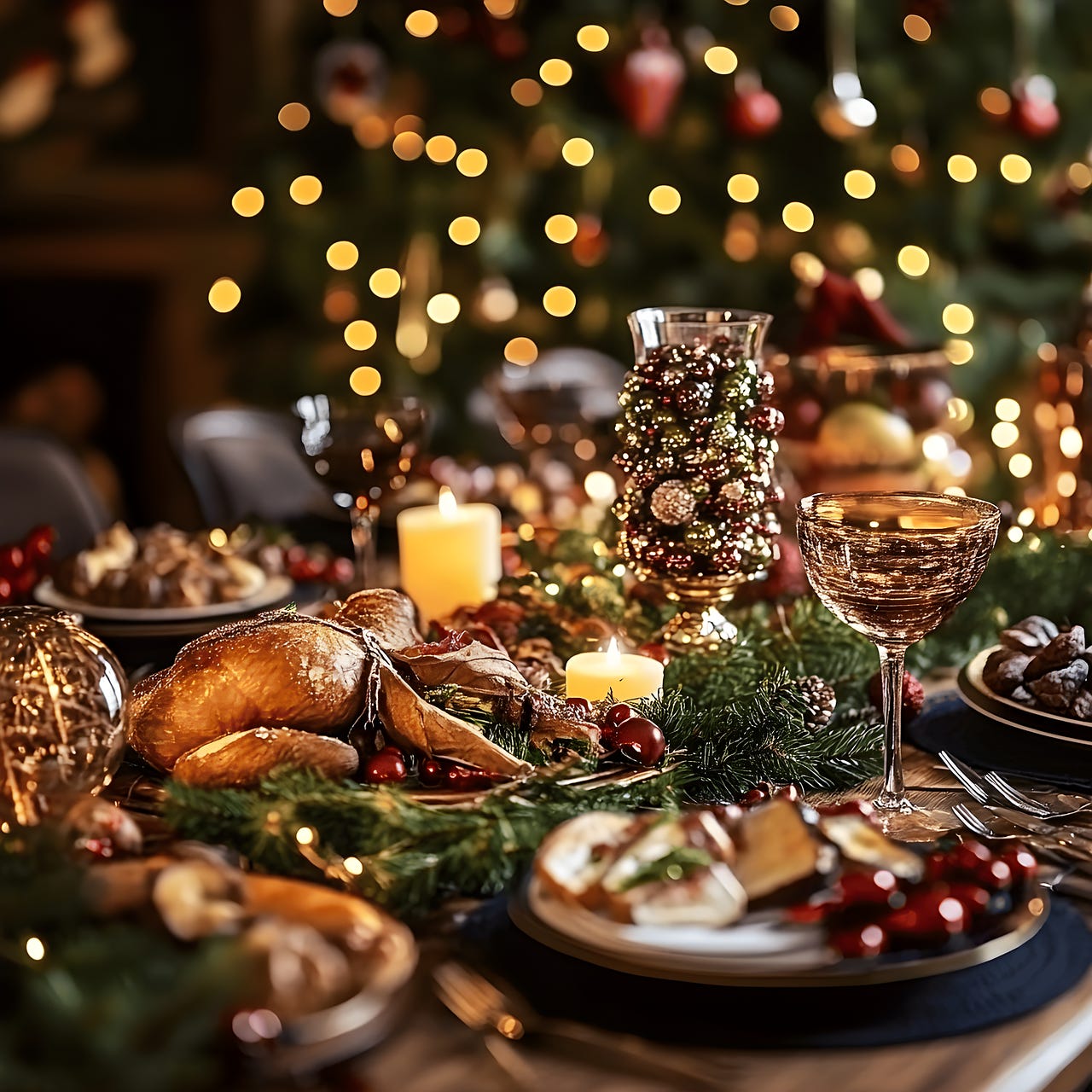
The kitchen table could have looked something like this. Everyone was eager to enjoy the good food. Image by Ivana Tomaskova from Pixabay.
There were pies and cranberry sauce, peas, corn, and lima beans, that had come from their well-stocked freezer. Yes, and pickles, relish, and jellies, that Mary had canned last summer. It did his heart good to see the children’s eyes bulge at the sight of all that food. He was ready to bet they hadn’t sat down to such a feast in many a day.
“We’re just farmers here,” he chuckled. “There’s nothing rich or fancy about us, but we eat well. Yes sir, we eat well!”
Then as they became quiet, he bowed his head to ask a blessing. “Dear God,” he prayed, “we thank Thee for this day on which we celebrate the beginning of the greatest sacrifice. We thank Thee for continued health and for the food Thou has supplied in such abundance. But most of all, we thank Thee for these unexpected guests, who have come to brighten the bleakness of our day. Wilt Thou go with them and prosper them in their new home. All this we ask in His dear Name, amen.”
During the meal Mrs Lewis explained further about their reason for being stranded. “George is a pressman,” she began in her soft southern voice. “He was working for a publishing company in Chicago. We’d bought a home there. We were doing pretty well.”
“But something went wrong, bad management, I guess. Anyway, the company went out of business and George was out of work. He couldn’t find another position. The publishing business really isn’t what it used to be. His unemployment insurance ran out. He had some life insurance, and we borrowed all we could on that. And then, I had appendicitis and had to have an operation.”
“We were at wits end, when my father wrote that he had a job for George on a newspaper down near home. We’d sold our house and used our equity to pay our bills, so all we had to do was to pile into the car and start out. If it hadn’t been for this storm, we’d have been there tonight.”
After the meal, John and George took the tractor, a log chain, and some shovels and set out to get the stranded car. But they found this no small task. The car was all but buried in drifts, and the tractor wheels found poor footing on the snow-covered road. It took hours of shovelling, hitching and re-hitching, to get it on the road again. It was dark when they got back to the farmhouse.
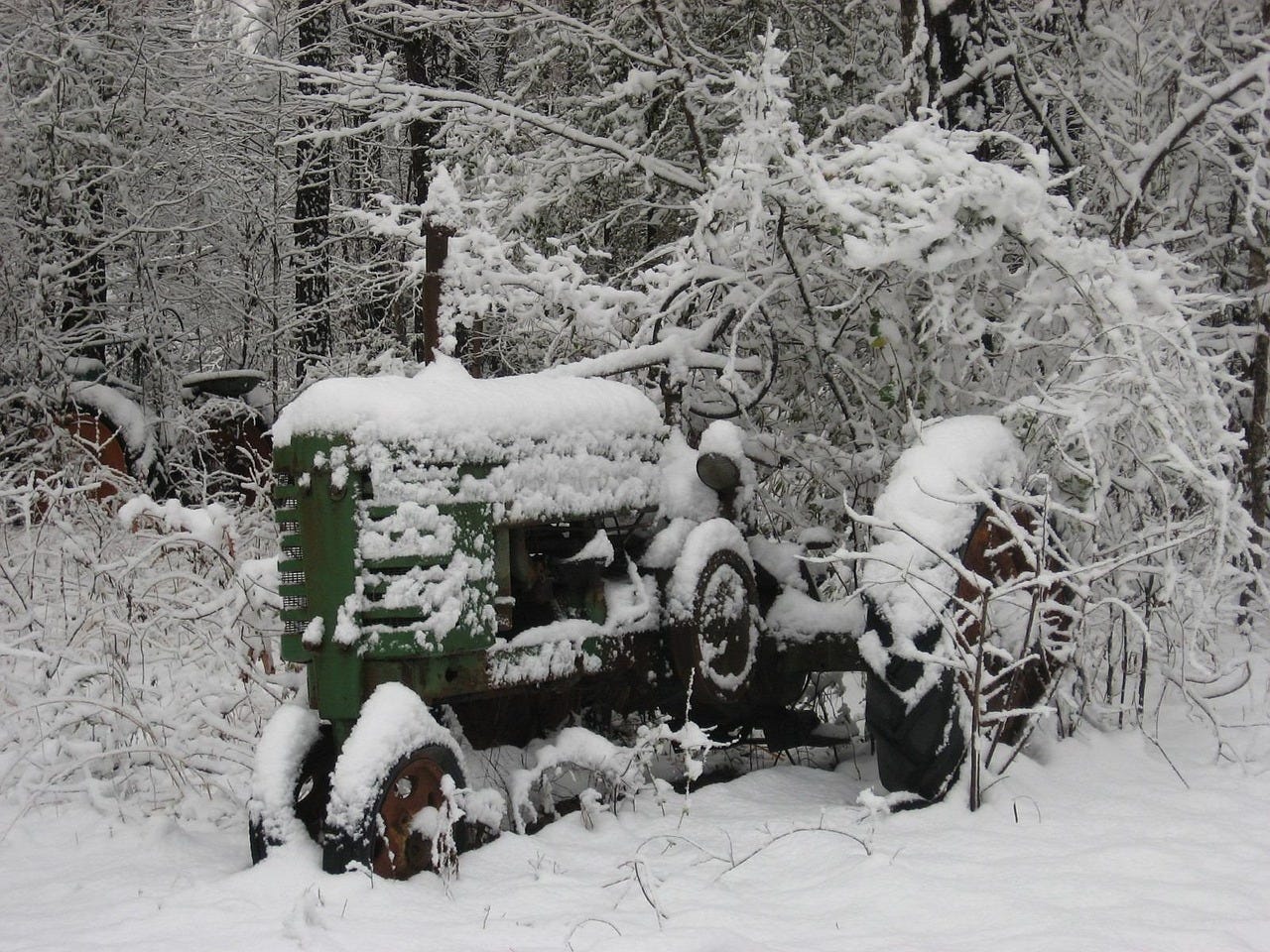
They set out with the tractor to try and get the car out of the snow drift. Image by Claudia Trapp from Pixabay.
The Lewises wanted to push on at once, but the Channings wouldn’t permit it.
“Nonsense!” said John. “The snow hasn’t stopped falling yet, and they have hardly begun to clear the roads. You wouldn’t go five miles till you’d be stranded again. You’ll stay here tonight and go on tomorrow, when the going will be better.”
“If you’d like,” he addressed George, “you can help me do my feeding. It’s way past time now.”
After a late supper, they were listening as Marty, the 4-year-old, recounted her version of the journey. “An’ we stayed all night in a motel,” she piped, “an’ Santy Claus never comed at all. I guess he jus’ couldn’t find us.”
John took his wife aside. “You’ve got a bunch o Molly’s old things in the attic,” he said. “I think there’s even some toys. Why don’t we.”
“But John…” she interrupted.
There was a trace of bitterness in his voice again as he said, “Yes, I know, you won’t part with them, because they’re Molly’s. Has Molly ever looked at them in recent years? Does she even know they’re there - or care? Why not get some good out of them?”
In the end, Mary was quite as happy as he to bring down the big box of clothes from the attic and pick out things for each of the girls. She even managed to find a little leather jacket for Bobby, one that had belonged to Bill years ago. It was a little large, perhaps, but it would keep him warm, and he’d grow into it.
When Mary began to pass out dolls to the little girls, John went out to the garage to get the baseball bat and glove his son had once loved with unbelievable passion though John would never admit the twinge it gave his own heart to part with them. When he came back, he found Mary crying softly over the picture little Lora made in a little velvet dress and fur trimmed coat that had once been Molly’s.
Sally, in a coat that had also been Molly’s not too many years before, pirouetted in front of her Mother.
You know, Mommy,” she beamed, “this is just the best Christmas we ever had!”
Sally expressed her joy at spending the Christmas evening with new friends in the farmhouse. Photo by Stephanie Kiepacki on Unsplash.
Some time later, John himself echoed almost those same words. He was standing in the middle of the bedroom, winding his alarm clock. He was dead tired, and his muscles ached from from hours of unaccustomed work in the cold and snow. But for the first time in years, every bed in the big old house was full, and he would long remember the shining eyes and laughing voices of these children.
“You know, Mary,” he mused, “this was just about the nicest Christmas we ever had.”
And his wife, already in bed before him, murmured sheepishly, “Yes John, I do believe it was.”
Christmas is where the heart is with family and God. Thanks for sharing.
Thank you Dad. That was a touching Christmas story!